

Lightning Protection for Sailing Boats

Sailing boats and other vessels at sea, at anchor, or ashore, are at risk of being struck by lightning. So, how can you protect a boat from lightning? Lightning protection can be quite straightforward when it comes to safeguarding your boat. Essentially, lightning protection consists of an air-termination system, a down conductor system, and an earth-termination system.
The air-termination system 'catches' the lightning or intercepts it. The down conductors ensure that the lightning current flows to the earth electrode, and the earth electrode ensures that the lightning current is discharged into the ground. In the case of a sailing boat, this means into the sea.
For a sailing boat, it is crucial to have a conductive connection from the top of the mast to the keel, and to the conductive part of the keel that is in contact with the sea. This way, if lightning strikes the mast or the air-termination rod, most of the lightning current is discharged through the body and into the water.
A bigger challenge is managing other conductive parts on the boat, which can be at completely different potentials at different times. To ensure adequate protection, it is necessary to equalize the potentials, meaning all metal parts must be properly connected. Proper equipotential bonding ensures that all metal parts are at the same potential (voltage) level.
Electronic equipment is particularly sensitive. Induced voltages and flashovers can cause problems during a lightning strike. Lightning can produce currents of up to 200kA with a shock waveform of 10/350µs, which means high frequency and a very high magnetic field.
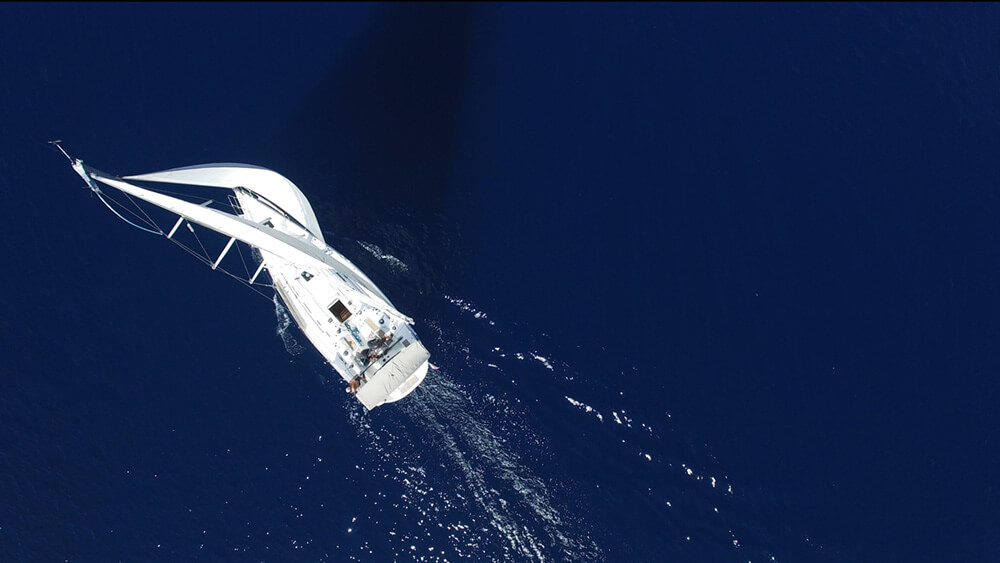 10% of the boat accidents that resulted in death have been occurred by lightning strikes.
Let's use a building as an example. In a building with a cage-shaped perimeter where the lightning conductor installation is mounted, the influence of the magnetic field along the individual current-carrying down conductors reduces in the interior while strengthening on the exterior. Thus, induced voltages are significantly lower.
Unfortunately, this is not the case for sailing boats. On boats, there is no decrease in the influence of the magnetic field, and the induced voltage in the loops or conductors can easily exceed several kV. This means damage to electronics may be unavoidable, so the use of shielded cables and the installation of appropriate surge arresters should be considered for adequate protection.
The type, number, and placement of surge protection devices depend on the individual case.
Photo: Foto & Film Air Video pl / Pixabay